Edinburgh · Loft Boarding Materials
Most loft boarding materials lists stop at the boards. The boards are the easy part. It’s everything else on the list that decides whether the floor lasts.
What this guide covers
- Loft boarding materials: more than just the boards
- The boards themselves: a quick word on material choice
- Materials needed for loft boarding: the full list
- Materials required to board a loft yourself vs having it surveyed
- Cheapest material to board a loft: where corners get cut
- Edinburgh, Leith, Corstorphine and Musselburgh: local considerations
- Who’s behind this guide
- Frequently asked questions
Key Takeaways
- Loft boarding materials cover far more than the boards: support legs, fixings, and insulation all belong on the list.
- Materials needed for loft boarding change depending on whether the floor is raised on legs or fixed straight to joists.
- The cheapest material to board a loft with isn’t always the cheapest option overall once insulation performance is factored in.
- Older Edinburgh properties often need extra materials that a standard checklist doesn’t account for.
- A survey removes the guesswork of quantities, since loft shape and obstacles rarely match a simple calculation.
Search “loft boarding materials” and most results give you a list of board types, chipboard, OSB, plywood, and stop there. That’s only one item on a longer list. A finished, working loft floor needs a support system, the right fixings, and often some attention to insulation too, none of which show up if you only think about the boards.
This guide covers the complete list of materials a loft boarding job actually needs, what changes depending on your approach, and where cutting costs on materials tends to cause problems later.
Loft Boarding Materials: More Than Just the Boards
A loft boarding project has four main material categories: the boards themselves, a support system to raise them above insulation, fixings to hold everything together, and, depending on the loft’s current state, insulation to top up before boarding begins. Missing any one of these doesn’t stop the job, but it does affect how well the finished floor performs.
It’s a similar story to painting a wall and forgetting about primer, sandpaper, or masking tape. The paint is the visible result, but the materials around it decide how good, and how durable, that result actually is. Loft boarding works the same way: the boards get all the attention, while the supporting materials quietly determine whether the floor holds up in five years or needs redoing.
The Boards Themselves: A Quick Word on Material Choice
Chipboard, OSB, and plywood remain the three main options for loft boards, each with different strengths around cost, weight, and moisture resistance. Rather than repeat that comparison here, our dedicated loft flooring guide covers board types in full detail, including when moisture resistant boards are worth the extra cost.
Materials Needed for Loft Boarding: The Full List
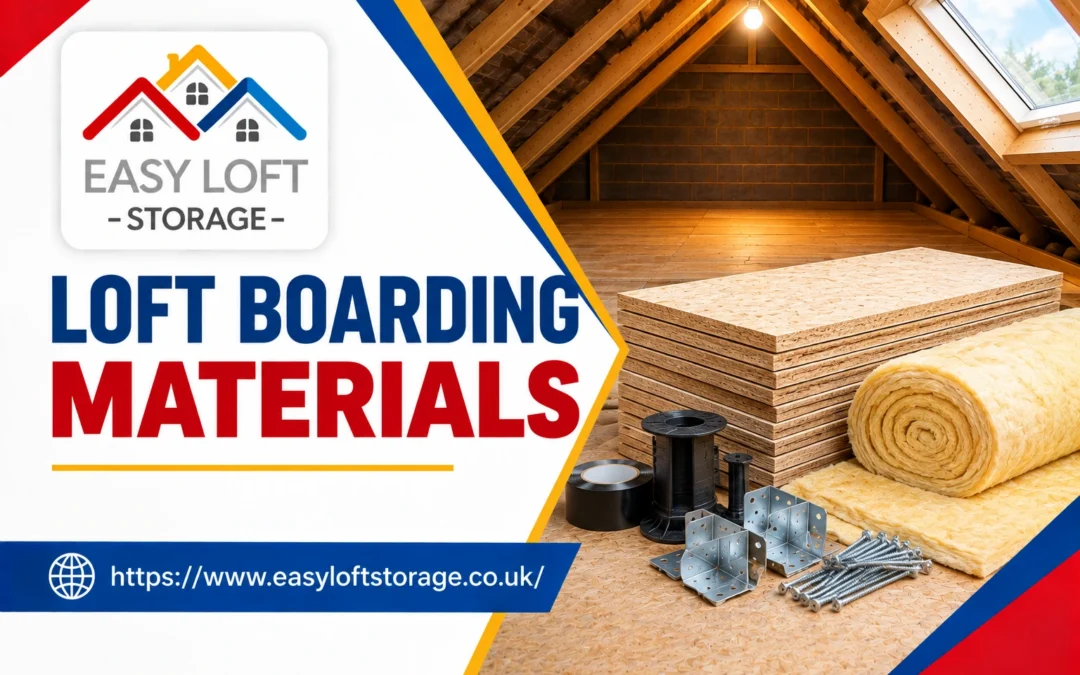
Beyond the boards, the materials needed for loft boarding typically include the following:
The Complete Materials Checklist
What a properly specified loft boarding job actually needs
Loft boards
Tongue and groove chipboard, OSB or plywood, usually 18mm thick.
Support legs or battens
Adjustable loft legs, or timber battens, to raise boards above insulation.
Fixings
Screws sized for board thickness, plus brackets for the support system.
Insulation top-up
Mineral wool or equivalent, if current depth falls short of 270mm.
Tools and safety equipment sit alongside the materials list rather than on it: a tape measure, saw, drill, dust mask and gloves are the basics most jobs need, particularly since cutting boards inside a loft creates more dust in a confined space than doing the same job outdoors. Knee pads are also worth adding to the list if you’re spending any real time kneeling on joists, since it’s an easily overlooked comfort item that makes a genuine difference on a longer job.
Buy slightly more boards than your calculation suggests. Loft shapes are rarely perfect rectangles, and offcuts around obstacles like water tanks add up faster than expected.
Materials Required to Board a Loft Yourself vs Having It Surveyed
Working out the materials required to board a loft yourself usually starts with measuring the floor area and calculating board quantity from there. This works reasonably well for a simple, rectangular loft with no major obstacles. It works far less well in a loft with sloped sections, water tanks, or joists that don’t match standard spacing, where the real materials list often looks different from the first estimate.
A professional survey removes this guesswork by measuring the actual space, checking joist condition, and specifying materials based on what’s really there rather than a rough floor plan calculation. This matters most for the support system, since the wrong leg height or spacing is far more disruptive to fix after boards are down than a slightly short stack of boards.
Cheapest Material to Board a Loft: Where Corners Get Cut
The cheapest material to board a loft with is almost always basic, non-moisture-resistant chipboard fixed straight to the joists with no support system. It’s genuinely the lowest upfront cost, but it’s also where the two most common long-term problems start: compressed insulation and, in poorly ventilated lofts, swollen or warped boards over time.
Choosing materials purely on upfront price without accounting for the cost of fixing insulation or replacing warped boards later. The cheapest material rarely stays the cheapest option once those follow-up jobs are factored in.
This doesn’t mean every job needs top-of-the-range materials. It means the comparison should be made honestly, weighing the small extra cost of moisture resistant boards or a proper support system against the far larger cost of redoing the work in a few years. For most Edinburgh lofts, that trade-off comes out clearly in favour of spending slightly more upfront.
A lightweight loft board material, paired with a proper raised support system such as the one used in our own loft boarding installations, tends to offer the better long-term balance between cost and performance.
Edinburgh, Leith, Corstorphine and Musselburgh: Local Considerations
What materials a loft actually needs changes depending on where in Edinburgh the property sits.
Leith tenements
Older, less ventilated lofts here usually call for moisture resistant boards and, in some cases, bespoke-cut battens where joist spacing doesn’t match standard support leg intervals. Materials often need to be brought through smaller, less convenient hatches too, which affects how boards should be sized before they even reach the loft.
Corstorphine semis
Typical 1930s lofts often need an insulation top-up added to the materials list, alongside standard boards and a raised support system. Joist spacing here is usually closer to modern standards, which simplifies the support leg selection.
Musselburgh new builds
Newer developments usually need the shortest materials list of the three, since insulation is already close to standard depth and joist or truss spacing is consistent, leaving material choice mostly down to preference rather than necessity.
For the full picture of loft flooring, insulation and access together, see our complete guide to loft storage in Edinburgh.
Who’s Behind This Guide
This guide is written from hands-on experience specifying and fitting loft boarding materials across Edinburgh and the surrounding area, including Leith, Corstorphine and Musselburgh.
Easy Loft Storage selects materials based on a proper survey of each loft, using our own trained team, rather than applying a single standard materials list to every property.
General product and safety information referenced in this guide draws on independent retailer buyer’s guides and was accurate at the time of writing. Where a loft’s shape or condition falls outside the ordinary, we recommend a proper survey over a standard materials list bought off the shelf.
Frequently Asked Questions
What materials are needed for loft boarding besides the boards?
A support system to raise boards above insulation, fixings sized for the boards, and sometimes insulation top-up material if current depth is below standard. Tools and PPE are needed alongside these.
What’s the cheapest material to board a loft with?
Basic chipboard fixed directly to joists with no support system is the cheapest upfront option, though it risks compressed insulation and, in damp lofts, warped boards over time.
Can I work out materials required to board a loft myself?
Yes, for a simple, regularly shaped loft with no major obstacles. Irregular shapes, sloped sections, or non-standard joist spacing make a survey-based estimate more reliable.
Is lightweight loft board material worth choosing?
It can be, particularly when paired with a raised support system, since it reduces the load on joists while still providing a stable, walkable floor.
Do older Edinburgh properties need extra materials for loft boarding?
Often, yes. Limited ventilation and irregular joist spacing in older properties can mean moisture resistant boards or bespoke-cut supports are needed alongside the standard materials list.
Skip the Guesswork on Materials
Book a free survey and we’ll specify exactly what your loft needs, not a generic list.
Get a Free Loft Survey →


