


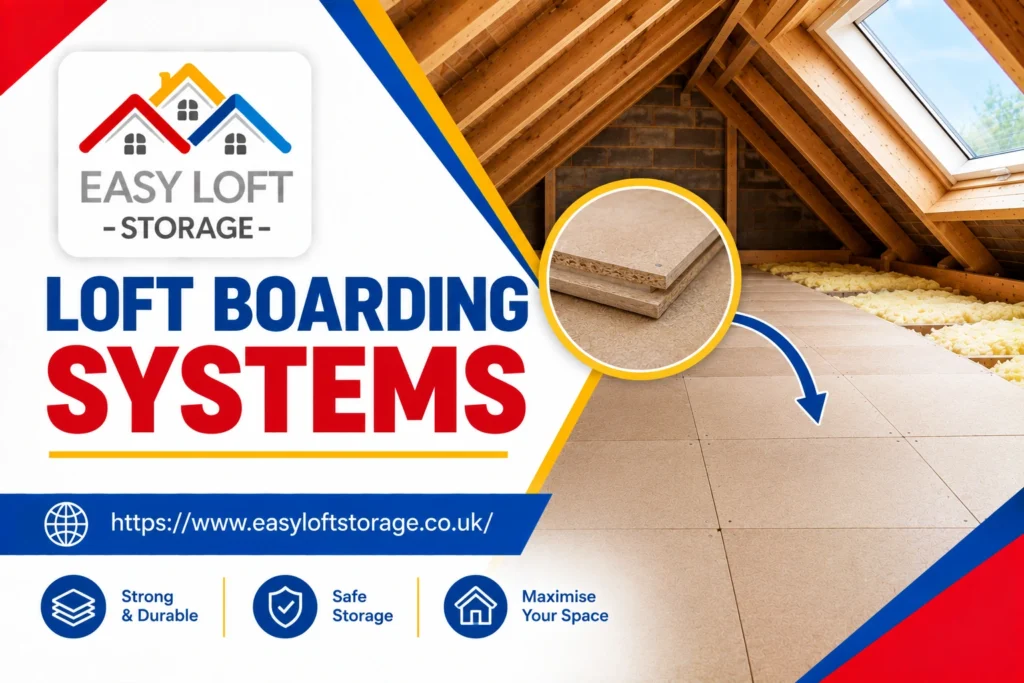
Edinburgh · Loft Boarding
Lay boards straight onto your joists and you’ll flatten the insulation underneath within a year. The right loft boarding system keeps your storage solid and your heating bill down, at the same time.
What this guide covers
- What a loft boarding system actually is
- Direct-lay boarding: the cheapest loft boarding system, and its downside
- Raised boarding system: the one that protects your insulation
- Batten systems: a lower-cost middle ground
- Which loft boarding system suits your property?
- Loft boarding systems in Edinburgh, Leith and Corstorphine
- Who’s behind this guide
- Frequently asked questions
Key Takeaways
- There are three main loft boarding systems: direct-lay, raised-leg, and batten.
- Direct-lay is cheapest but compresses insulation, cutting its effectiveness significantly.
- A raised boarding system holds boards above the insulation on legs, keeping it at full depth.
- The right system depends on your current insulation depth, roof type, and what you plan to store.
- Edinburgh’s mix of tenements, semis and new builds often calls for different systems on the same street.
“Loft boarding” sounds like one job, but there isn’t just one way to do it. The system you choose decides whether your loft insulation keeps working properly, how much weight the floor can safely take, and how much the job costs.
This guide walks through the three main loft boarding systems used in the UK, which one suits which property, and what that looks like across Edinburgh’s older tenements, 1930s semis and newer builds.
What a Loft Boarding System Actually Is
A loft boarding system is simply the method used to get a solid floor into your loft, boards, support structure, and how they sit relative to your insulation. It’s a different question from which board material to use. Our loft flooring guide covers chipboard, OSB and plywood in detail; this guide covers the system underneath those boards.
Get the system wrong and the material choice barely matters, because a flattened layer of insulation under a perfectly good board still means a colder loft and a less efficient home.
Direct-Lay Boarding: The Cheapest Loft Boarding System, and Its Downside
Direct-lay means screwing boards straight onto the joists, with no raised support in between. It’s the fastest and cheapest of the loft boarding systems, and it’s only really appropriate where insulation is shallow, around 100mm or less, so there’s little to compress.
Most UK lofts don’t meet that condition anymore. With the recommended depth for mineral wool sitting at 270mm, direct-laying onto a loft with proper insulation crushes it flat under the boards, cancelling out a large share of its thermal performance. It’s a false saving, since you end up paying for insulation that isn’t doing its job.
Choosing direct-lay because it’s the cheapest quote, without checking existing insulation depth first. If you’ve already got 270mm down, direct-lay undoes a large part of what that insulation cost you.
Raised Boarding System: The One That Protects Your Insulation
A raised boarding system fixes support legs to the joists first, at a height matching your insulation depth, then lays boards across the top of the legs. The insulation stays untouched underneath, full depth, uncompressed, while the boards above give you a solid, level floor for storage.
This is the system we recommend for the vast majority of Edinburgh lofts, since most properties already have or need insulation at or near the 270mm recommended depth, and compressing that defeats the purpose of having it. Leg height is simply matched to depth, so a loft insulated to 270mm gets 270mm legs, keeping the whole system level.
There’s a knock-on cost benefit too, even though the system itself costs more than direct-lay upfront. Insulation that stays at full depth keeps doing its job for the life of the roof, rather than losing a chunk of its effectiveness the day the boards go down. Over several winters, that difference in heat retention is usually worth more than the price gap between the two systems, which is why we steer most customers towards raised boarding rather than the cheapest option on paper.
Planning to store anything heavy up there, suitcases, boxes of books, furniture? A raised boarding system on standard joists still has a weight limit. Our guide to loft boarding for heavy storage covers when you need reinforced joists as well.
See our loft boarding service for how we fit raised systems as standard on properties with full-depth insulation.
Batten Systems: A Lower-Cost Middle Ground
A batten system raises boards using timber battens laid across the joists rather than individual plastic or metal legs. It achieves a similar result to a raised boarding system, keeping insulation largely uncompressed, usually at a slightly lower material cost, though it typically gives less precise height control than adjustable legs.
It suits lofts where the budget is tighter but direct-lay still isn’t appropriate because of insulation depth. It’s a reasonable middle option rather than a downgrade, and worth discussing at survey stage if cost is the main driver.
What battens can’t do as well as legs
The trade-off with a batten system is precision. Adjustable legs let you fine-tune height to match insulation depth exactly, and to compensate for small dips or humps in the joists underneath. Battens are fixed-height timber, so getting a perfectly level floor across an uneven loft takes more care, packing or shimming individual sections rather than a simple height adjustment. For a small, regular loft this rarely matters. For a larger or more irregular space, it’s worth factoring into the decision.
Which Loft Boarding System Suits Your Property?
| Situation | Recommended system |
|---|---|
| Shallow insulation (under 100mm) | Direct-lay, or top up insulation first and switch to raised |
| Standard depth insulation (270mm) | Raised boarding system |
| Tight budget, 270mm insulation | Batten system |
| Heavy storage plans | Raised system, with joist assessment first |
| New-build trussed roof | System matched to truss spacing, assessed individually |
Older, irregular loft spaces sometimes need a bit more judgement than this table alone can give. If your property is a traditional tenement, our loft boarding for older properties guide covers the structural checks worth doing before any system goes in.
It’s also worth getting the insulation itself assessed at the same time as the boarding system, rather than treating them as two separate decisions made months apart. If insulation needs topping up to reach 270mm anyway, doing that before legs go in means the whole system is sized correctly from the start, instead of retrofitting leg height later. Our loft insulation thickness guide covers how to check what depth you’ve currently got.
Loft Boarding Systems in Edinburgh, Leith and Corstorphine
Which system makes sense varies across Edinburgh’s different housing types.
Leith and central Edinburgh tenements
Traditional roof structures here usually call for a raised boarding system once insulation is brought up to standard depth, alongside the structural checks that come with older construction generally.
Corstorphine semis
1930s construction typically takes a straightforward raised or batten system without complication, assuming insulation is already at or near 270mm.
Whatever system suits your loft, our complete guide to loft storage in Edinburgh covers the wider picture, from insulation to boarding to what to store where.
Who’s Behind This Guide
This guide is written from hands-on experience fitting all three loft boarding systems across Edinburgh and the surrounding area, including Leith, Corstorphine and Musselburgh.
Easy Loft Storage assesses insulation depth and roof structure before recommending a system, rather than defaulting to the cheapest option regardless of what it does to your insulation.
Insulation depth and compression figures referenced in this guide reflect current UK loft insulation guidance and were accurate at the time of writing.
Frequently Asked Questions
What are the main types of loft boarding systems?
The three main systems are direct-lay (boards fixed straight to joists), raised-leg (boards raised on legs above insulation), and batten (boards raised on timber battens). Each suits a different combination of budget and insulation depth.
Is a raised boarding system worth the extra cost?
Usually, yes, if your loft has standard-depth insulation. Direct-lay compresses that insulation significantly, reducing its thermal performance, which costs you more in lost heat over time than the system upgrade did upfront.
Can I fit a loft boarding system myself?
Direct-lay and basic batten systems are within reach for a confident DIYer. A raised-leg system over full-depth insulation, especially with structural checks involved, is usually worth having assessed professionally first.
Does the loft boarding system affect how much weight I can store?
Yes. The system distributes weight differently, and on standard joists, none of the three systems increases the loft’s underlying weight capacity. Heavier storage plans need a joist assessment regardless of boarding system.
Which loft boarding system is best for a new build?
It depends on the roof structure. New builds with engineered trusses need a system matched to truss spacing rather than a standard joist assumption, so this is worth assessing property by property.
Get the Right System for Your Loft
Book a free survey and we’ll recommend the loft boarding system that protects your insulation and suits your storage plans.
Get a Free Loft Survey →